Blog
The Heavy Truth: Choosing the Right Wall Fixings for Radiators

The Heavy Truth: Choosing the Right Wall Fixings for Radiators
Don't let your heating system become a floor decoration. Here is the definitive guide to wall anchors, specifically for the heavy, hot, and water filled world of radiators.
If you have ever stood in a hardware aisle staring at a wall of plastic plugs wondering, "Will this actually hold?" you are not alone.
At The Radiator Hub, we see this constantly. Customers buy a beautiful designer radiator, only to hang it with standard wall plugs that pull out six months later. Why? Because radiators aren't just "heavy pictures." They are dynamic systems.
This guide combines load data with real-world installation physics to help you choose the safest fixing for your wall.
The "Radiator Reality" Check
Before looking at the fixings, you must understand why radiators are different from shelves or TVs.
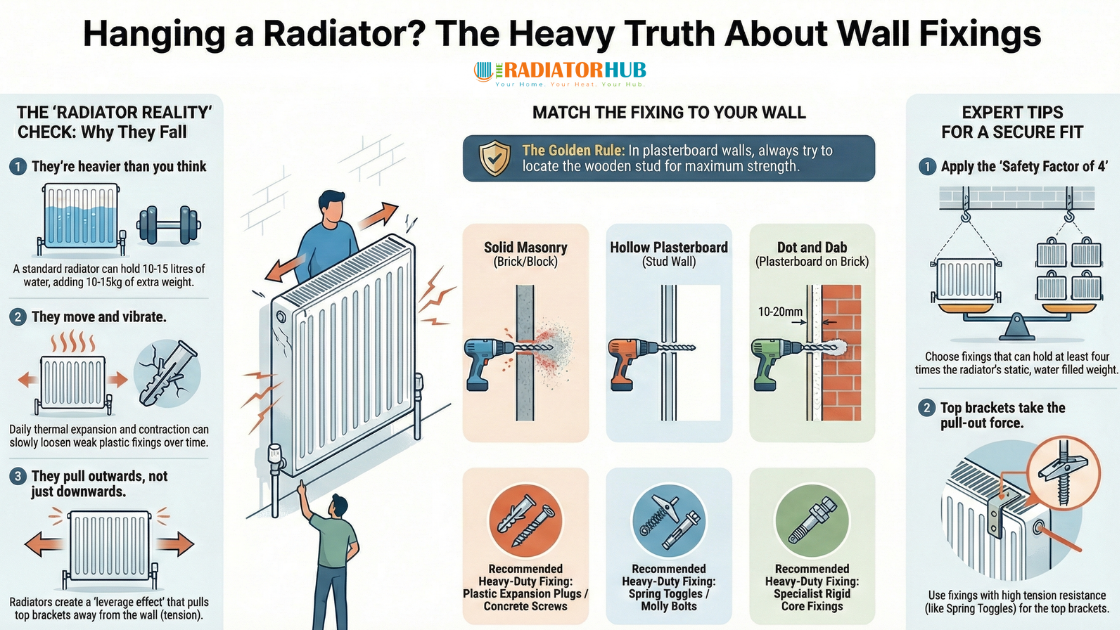
- The Water Weight Factor: A radiator is significantly heavier once installed. A standard vertical radiator can hold 10-15 litres of water. That is an extra 10-15kg of "invisible" weight you must account for.
- Thermal Expansion: Radiators heat up and cool down daily. This causes the metal (and the pipes) to expand and contract. This microscopic movement vibrates fixings. If you use a cheap plastic plug, it will eventually loosen.
- The "Leverage" Effect: Radiators stick out from the wall. The weight isn't just pulling down (shear); it is pulling the top brackets out (tension).
Phase 1: Identify Your Wall
The fixing you choose is useless if it doesn’t match the wall type.
Solid Masonry (Brick/Block/Concrete)
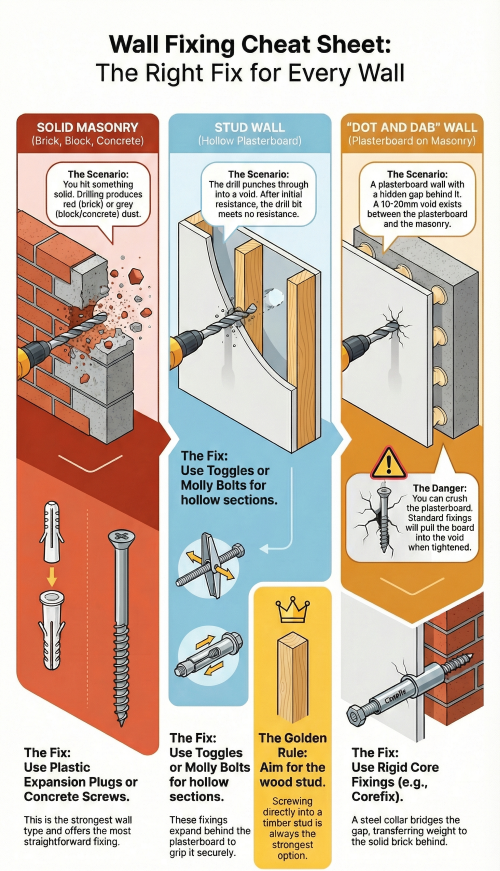
- The Scenario: You drill a hole and hit red dust (brick) or grey dust (block).
- The Fix: You are in luck. This is the strongest wall type. You can use Plastic Expansion Plugs or Concrete Screws.
Stud Wall (Hollow Plasterboard)
- The Scenario: The drill pushes through easily, then hits a void.
- The Fix: You need Toggles or Molly Bolts.
- The Golden Rule: Always try to find the timber “stud” (vertical beam) behind the plasterboard. Screwing directly into wood is stronger than any toggle.
“Dot and Dab” (The Tricky One)
- The Scenario: Plasterboard stuck to brick with blobs of adhesive, leaving a 10-20mm gap in between.
- The Danger: If you tighten a radiator bracket here, you will crush the plasterboard into the void.
- The Fix: You need Rigid Core Fixings (like Corefix or Rigifix). These bridge the gap with a steel collar so the weight transfers to the brick, not the plasterboard.
Phase 2: The Fixing Hierarchy (Data & Verdicts)
We have ranked common fixings by their Real World capability.
Note: Max loads below refer to shear weight per fixing point.
The "Avoid" Zone (Lightweight Only)
Fixing Type | Max Load (Approx) | Best Used For | The Radiator Hub Verdict |
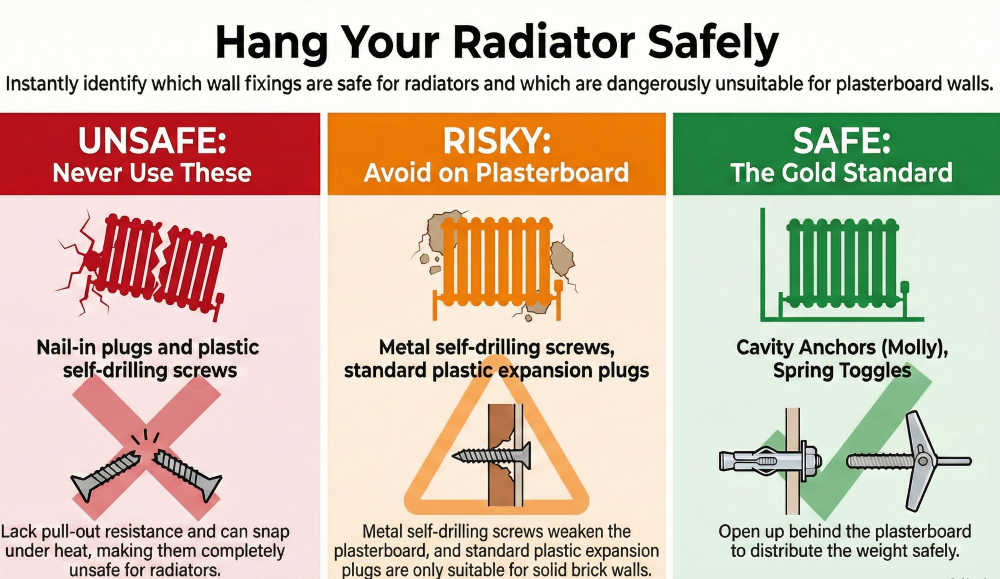
Nail-in Plug | 3 - 5 kg | Lightweight pictures, cable clips | NEVER. These have zero pull-out resistance. |
Self-Drilling (Plastic) | 5 - 10 kg | Picture frames, small hooks | UNSAFE. Plastic snaps under the heat cycles of a radiator. |
The "Proceed with Caution" Zone (Medium Load)
Fixing Type | Max Load (Approx) | Best Used For | The Radiator Hub Verdict |
Self-Drilling (Metal/Zinc) | 10 - 15 kg | Mirrors, small shelves | RISKY. Only for tiny, empty towel rails. They chew up the plasterboard, leaving it weak. |
Plastic Expansion Plug | 10 - 20 kg | Curtain rails, shelving | MASONRY ONLY. Great for brick walls. Useless on hollow plasterboard (they will pull straight out). |
The "Radiator Safe" Zone (Heavy Duty)
Fixing Type | Max Load (Approx) | Best Used For | The Radiator Hub Verdict |
Cavity Anchor (Molly) | 20 - 50 kg | Cabinets, TV brackets, Standard Radiators | GOOD. The metal "umbrella" opens behind the wall, spreading the load. Reliable for standard radiators. |
Spring Toggle | 15 - 40 kg+ | Heavy Radiators, Large TVs | GOLD STANDARD. Specifically metal toggles (like SnapToggles). They distribute weight across a large area of the board. |
Phase 3: Expert Installation Tips
The "Safety Factor" of 4
Never match the weight exactly. If your radiator weighs 20kg (filled), do not use a fixing rated for 20kg.
- Why? People lean on radiators. Kids climb on them.
- The Formula: Aim for fixings that can hold 4x the static weight of the radiator.
Tension vs. Shear
- Top Brackets: These take the "pull-out" force. You need fixings with high tension resistance (like Spring Toggles).
- Bottom Brackets: These take the "slide-down" force. You need fixings with high shear resistance.
The Vibration Test
Because radiators vibrate slightly due to thermal expansion, ensure you add a washer between the screw head and the radiator bracket. This acts as a small shock absorber and prevents the screw from grinding into the bracket over time.
Summary Checklist: Before You Drill
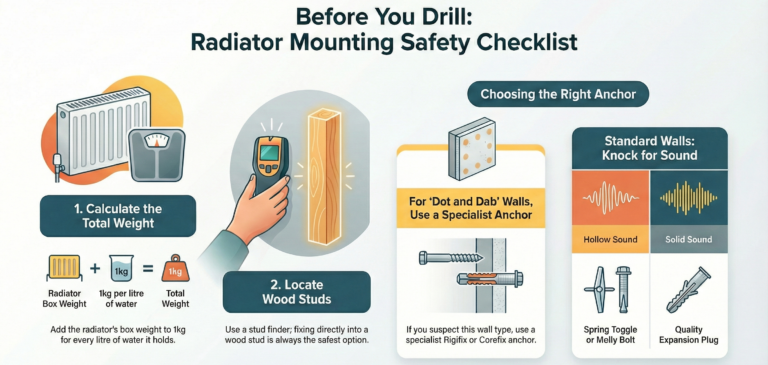
- Weigh it up: Check the radiator box weight + add 1kg for every litre of water capacity.
- Knock the wall: Hollow sound? Use a Spring Toggle or Molly Bolt. Solid sound? Use a Quality Expansion Plug.
- Check for studs: Use a stud finder. Fixing into wood is always safer than fixing into plasterboard.
- Dot and Dab: Do not guess. Use a specialist Rigifix or Corefix anchor.