Blog
Can a Towel Rail Heat a Bathroom? Key Facts Before Buying

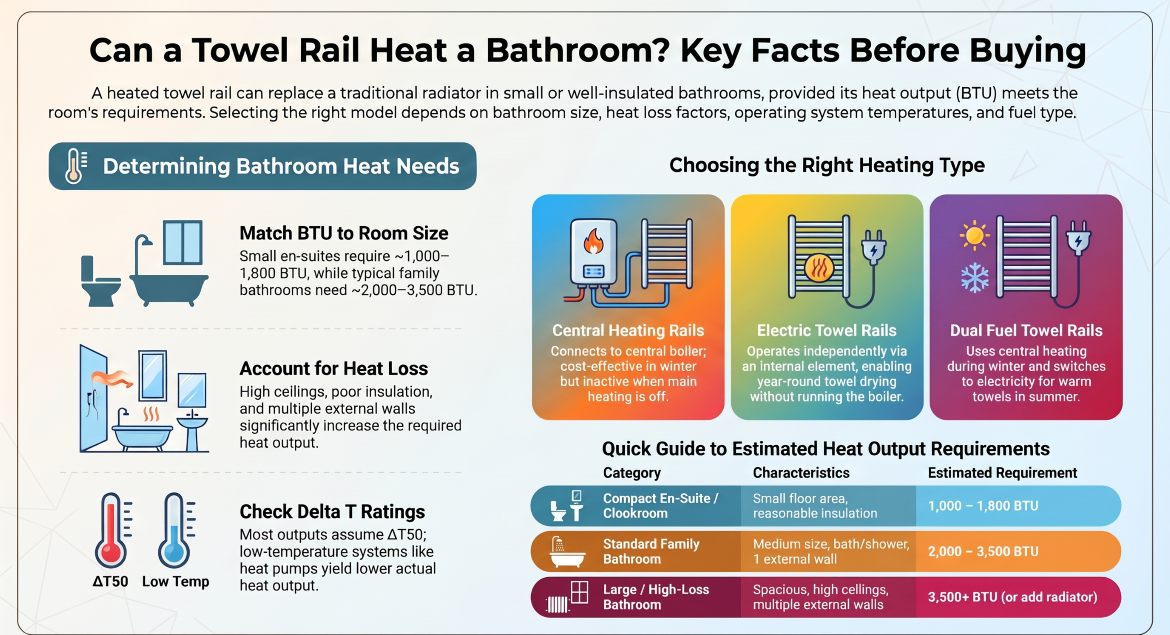
Choosing a towel rail for your bathroom seems straightforward until you start wondering whether it will actually keep the room warm. After all, there’s little point in having beautifully warm towels if the rest of the bathroom still feels cold.
So, can a heated towel rail replace a traditional bathroom radiator?
In many cases, yes. A towel rail can provide enough heat for a small or medium-sized bathroom, but the right choice depends on the room’s size, insulation, and overall heating requirements. Larger bathrooms may need a higher-output towel rail or an additional heat source.
Before buying, it’s worth understanding how much heat your bathroom needs and what to look for when comparing different models.
Can a Heated Towel Rail Replace a Bathroom Radiator?
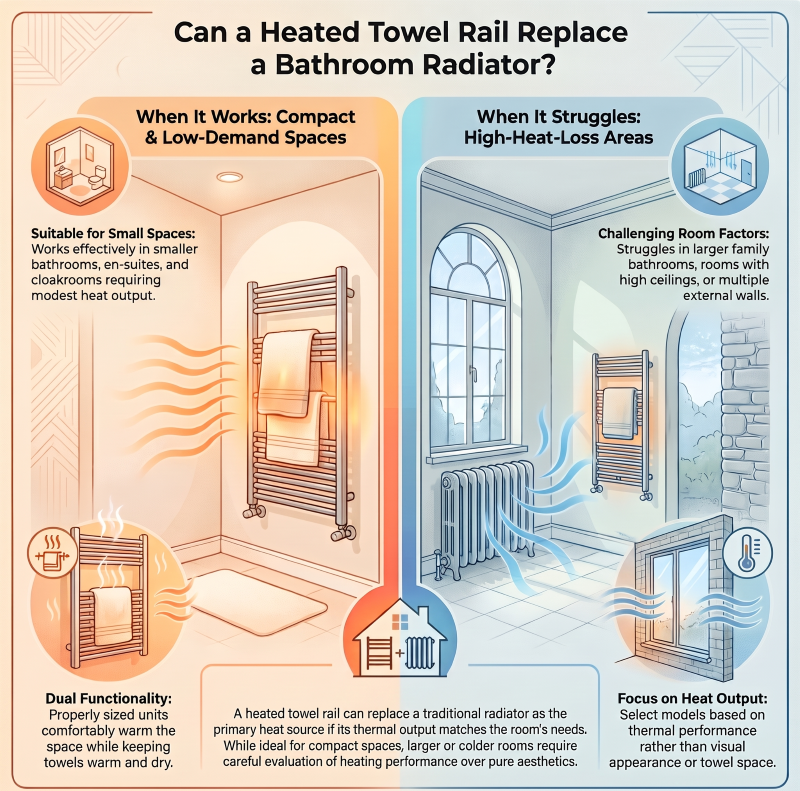
A heated towel rail can act as the main heat source in a bathroom, provided its heat output is sufficient for the space.
This is often possible in smaller bathrooms, en-suites and cloakrooms, where the amount of heat required is relatively modest. A correctly sized towel rail can warm the room while keeping towels comfortable and dry.
However, not every towel rail is designed to heat an entire room. Some models are primarily chosen for their appearance and towel-hanging space rather than their heat output.
If you have a larger family bathroom, a high ceiling, or several external walls, a standard towel rail may struggle to maintain a comfortable temperature during colder weather.
Choose a model based on its heating performance, not just its appearance.
What Affects How Much Heat Your Bathroom Needs?
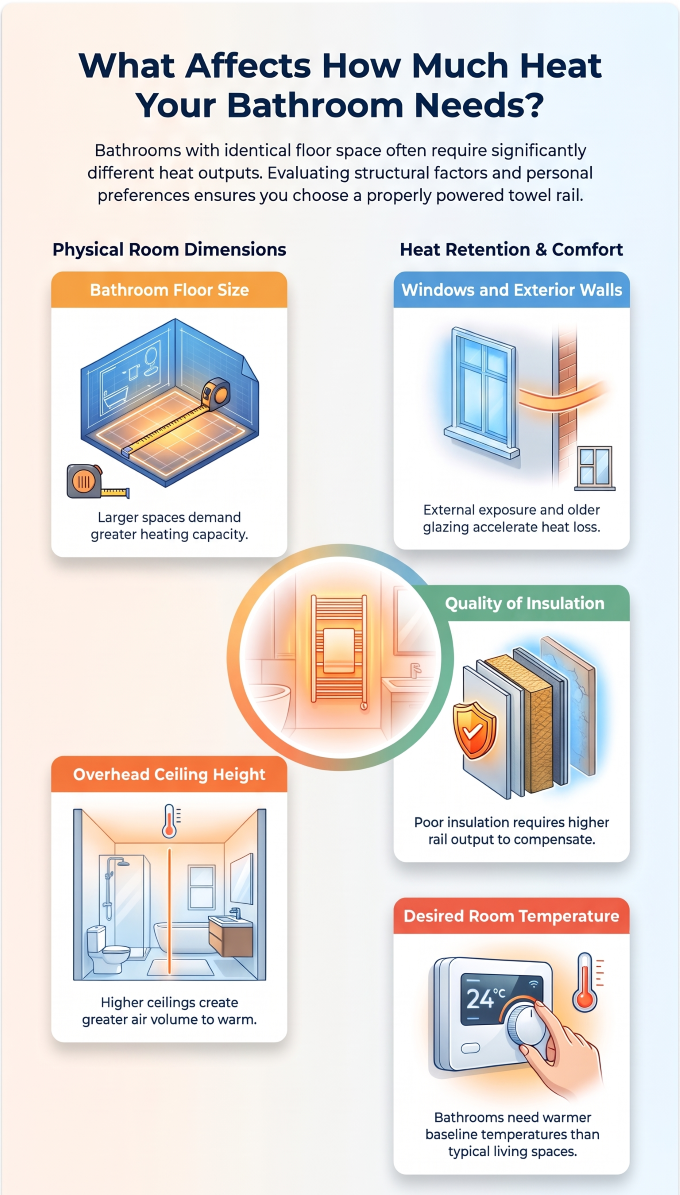
Two bathrooms with similar floor areas can have quite different heating requirements. That's because several factors affect how quickly a room loses heat.
Here are the main things to consider before choosing a towel rail.
Bathroom size
The larger the bathroom, the more heat it generally needs. A small en-suite will usually require less output than a spacious family bathroom with a separate shower and bath.
Windows and external walls
Bathrooms with large windows or multiple external walls can lose heat more quickly. Older or single-glazed windows can make this particularly noticeable during winter.
Insulation
Good insulation helps a room retain warmth. If your bathroom is poorly insulated, you may need a higher-output towel rail to compensate for heat loss.
Ceiling height
A bathroom with a high ceiling contains more air to warm than a room with a standard ceiling height. This can increase the amount of heat required.
Your preferred room temperature
Bathrooms are often kept warmer than other rooms in the house, particularly when people are getting ready or stepping out of the shower. Consider this when calculating the required heat output.
Taking these details into account will help you avoid buying a towel rail that looks right but doesn't provide enough warmth.
How Much BTU Does a Bathroom Need?
BTU stands for British Thermal Unit. When shopping for radiators and towel rails, it is used to describe how much heat a product can produce.
A higher BTU rating generally means greater heat output, making it an important figure to check before purchasing.
As a general illustration, smaller bathrooms may need around 1,000–1,800 BTU, while a typical family bathroom may require approximately 2,000–3,500 BTU. Larger or poorly insulated bathrooms can need considerably more.
These figures are broad estimates rather than fixed recommendations. The correct requirement depends on the room's dimensions, insulation, windows, external walls and desired temperature.
It's also important to check the conditions under which a towel rail's heat output has been measured.
Most radiator and towel rail outputs are advertised at ΔT50. This refers to the difference between the radiator's average water temperature and the surrounding room temperature. If your heating system operates at lower water temperatures, the actual heat produced will be lower than the advertised figure. This is particularly worth considering if you have a heat pump or another low-temperature heating system.
Before choosing a model, calculate your bathroom's heat requirement and compare it with the manufacturer's stated output. Make sure you're comparing product outputs using the same Delta T rating.
Use our free BTU calculator to estimate the heat needed for your room rather than relying on room size alone.
You can also read our radiator buying guide for more advice on choosing the right heating output.
When Is One Towel Rail Enough?
For many homeowners, a single towel rail is all that's needed. The key is choosing one with enough heat output for the bathroom.
A towel rail is more likely to work as the only heat source when:
- The bathroom is relatively small or medium-sized.
- The room has reasonable insulation.
- There aren't several large windows or external walls.
- The selected towel rail has sufficient BTU output.
- The heating system can supply the water temperature needed to achieve its rated output.
For example, a compact en-suite in a reasonably insulated home may be perfectly comfortable with one appropriately sized heated towel rail.
It also saves wall space compared with installing a separate radiator, which can be useful in smaller bathrooms.
When Might You Need an Additional Heat Source?
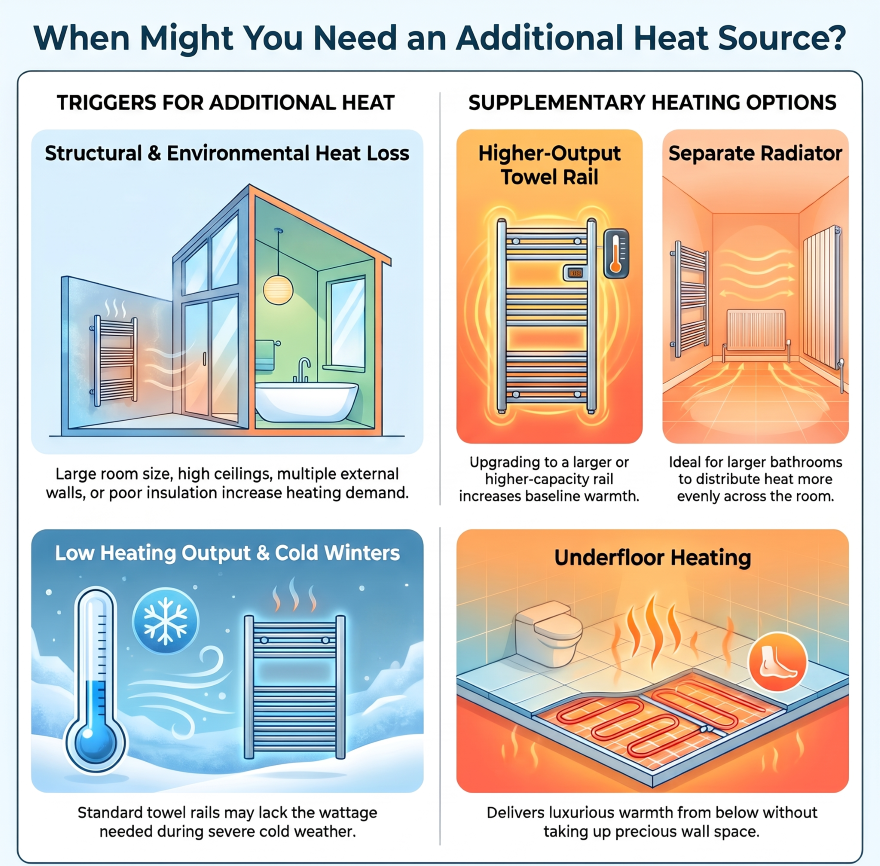
There are situations where a towel rail alone may not provide enough warmth.
You may need additional heating if your bathroom:
- Has a large floor area or high ceiling.
- Has several external walls.
- Contains large windows or limited insulation.
- Gets noticeably cold during winter.
- Has a towel rail with a relatively low heat output.
In these circumstances, you could choose a higher-output towel rail or combine it with another heating option.
A separate radiator can help distribute heat around a larger bathroom, while underfloor heating can provide additional warmth without taking up wall space.
The right solution depends on your available space, budget, and heating requirements.
Central Heating, Electric or Dual Fuel: Which Should You Choose?
Heated towel rails are available with different heating options, each offering its own benefits. The right choice depends on your existing heating system and how you want to use your bathroom.
Central heating towel rails
These connect to your home's central heating system and use hot water from the boiler to produce heat. They are a popular choice for bathrooms that already have central heating pipework.
However, they generally only heat up when the central heating system is running. If you're looking for a model that works with your existing heating setup, explore our range of Central Heating Towel Rails.
Electric towel rails
Electric models use a heating element rather than relying on your boiler. This means you can use them independently of the central heating, making them useful when you want warm towels or extra bathroom warmth during warmer months.
You can browse our collection of Electric Towel Rails to find options suited to your bathroom. Before choosing a model, it’s also worth considering its running costs. Read our guide to Electric Towel Rail Running Costs to understand how wattage, usage time and electricity prices can affect your energy bills.
Always check that the product is suitable for bathroom installation and have the electrical work completed by a qualified electrician in accordance with the relevant regulations.
Dual fuel towel rails
A dual fuel towel rail offers both central heating and electric operation. You can use the central heating during winter and switch to the electric element when the main heating is off.
This flexibility makes dual fuel models worth considering if you want warm towels throughout the year without having to run your whole heating system.
If you’re comparing different styles and heating options, explore our wider collection of bathroom radiators and heated towel rails to find a suitable option for your space.
For more information about the differences between heating types, read our guide: Electric vs Central Heating vs Dual Fuel Towel Rails: Which One Do You Need?
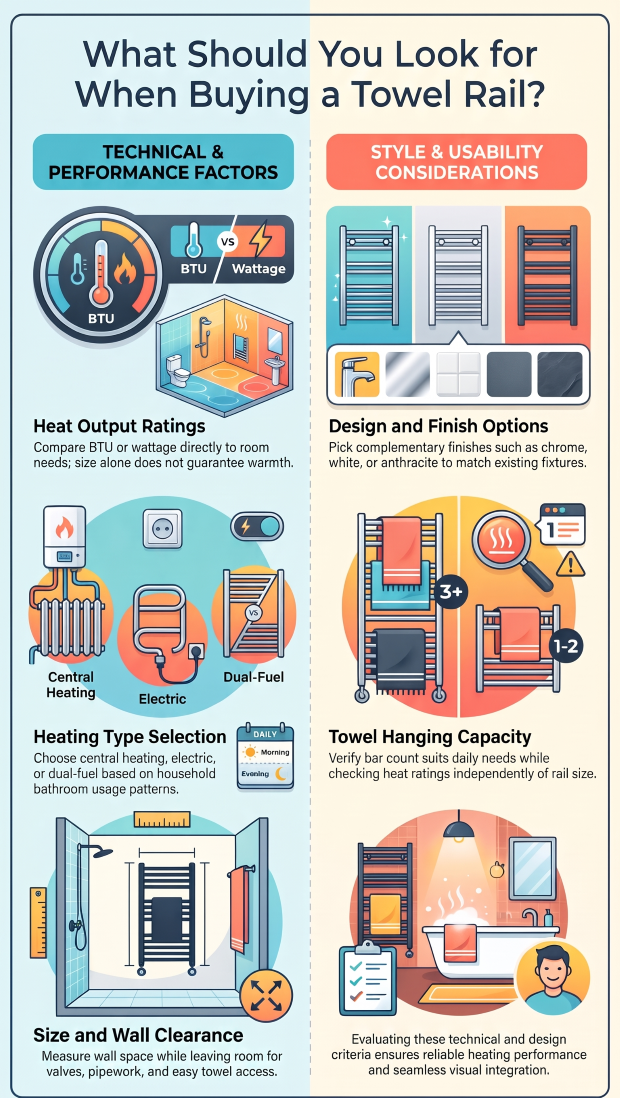
What Should You Look for When Buying a Towel Rail?
Once you know how much heat your bathroom needs, you can start comparing suitable models.
Here are a few things worth checking before placing an order.
Heat output: Always compare the BTU or wattage rating with your calculated room requirement. Don't assume that a taller or wider towel rail will automatically provide enough heat.
Size and available wall space: Measure the area where you intend to install the rail. Remember to allow enough room for pipework, valves and comfortable access to hang towels.
Design and finish: Choose a style that complements your bathroom. Chrome, white, anthracite and other contemporary finishes can all work well depending on your existing fittings.
Heating type: Decide whether central heating, electric or dual fuel operation best suits the way you use your bathroom.
Towel capacity: Consider how many towels you regularly need to hang. A rail with more bars may offer additional hanging space, although its heat output still needs to be checked separately.
If you're unsure whether a particular model will provide enough warmth, check its technical specifications or speak to a heating professional before ordering.
Taking a little time to compare these details can help you find a towel rail that looks good and performs well.
How Can You Get More Heat from Your Bathroom Towel Rail?
Choosing the right model is important, but a few practical steps can also help your bathroom feel warmer.
- Avoid overcrowding the bars: Hanging too many thick towels over the rail can restrict the amount of heat released into the room.
- Check your heating system: Make sure the central heating system is working properly and the towel rail is heating as expected.
- Use suitable heating controls: Timers and thermostats can help you heat the bathroom when it's needed rather than leaving it running unnecessarily.
- Improve ventilation: Use an extractor fan or open a window after showering to remove excess moisture and reduce condensation.
- Consider insulation: Addressing draughts and improving insulation can help your bathroom retain warmth for longer.
These small changes can make a noticeable difference to everyday comfort.
Frequently Asked Questions
Can a heated towel rail replace a normal radiator?
Yes. A heated towel rail can replace a conventional radiator if its heat output is sufficient to meet the bathroom's heating requirements. Always check the BTU rating before choosing one.
Why does my towel rail get hot but my bathroom stays cold?
This can happen when the towel rail doesn't produce enough heat for the room. It may also be due to poor insulation, large windows or low water temperatures in your heating system. Check the required BTU against the rail's actual output.
Are heated towel rails warm enough in winter?
They can be, provided they are correctly sized for the bathroom. However, smaller decorative models may not produce enough heat for larger or poorly insulated rooms.
Does hanging wet towels on a heated towel rail reduce its heat output?
Covering most of the rail with thick or damp towels can restrict heat transfer into the room. It's best to avoid overcrowding the bars and allow some space for warm air to circulate.
Should I choose a ladder towel rail or a designer towel radiator?
It depends on your priorities. Ladder towel rails offer practical hanging space and suit many modern bathrooms. Designer towel radiators come in different styles and sizes, so you may find options with a higher heat output. Always compare the manufacturer's BTU ratings.
Can I use an electric towel rail without switching on the central heating?
Yes. An electric towel rail operates independently of your central heating system. This makes it useful when you want warm towels or additional bathroom heating outside the main heating schedule. Choose a model suitable for bathroom installation and use a qualified electrician.
Are dual fuel towel rails worth buying?
They can be a good choice if you want to use your central heating in winter and electricity during warmer months. Whether the extra flexibility is worth the cost depends on how frequently you use your bathroom heating.
How do I know what size towel rail I need?
Start by measuring your bathroom and calculating its heat requirement in BTU or watts. Then compare that figure with the manufacturer's stated heat output. Consider insulation, windows, external walls and your heating system's operating temperature.
Final Thoughts
A heated towel rail can be a practical alternative to a traditional bathroom radiator, but choosing the right one makes all the difference. The size of your bathroom, insulation, heat output, and heating system all play a part in how well it performs.
If you're planning a bathroom upgrade, take the time to calculate your heating requirements before choosing a design. This will help you find a towel rail that not only looks good but also provides the warmth your bathroom needs.
At The Radiator Hub, we offer a range of bathroom radiators and towel rails in different styles and finishes to suit your space. Explore the collection and find the right balance of comfort, practicality and design for your bathroom.