Blog
The Best Column Radiators for Victorian Homes | A Complete UK Buying Guide

The Best Column Radiators for Victorian Homes
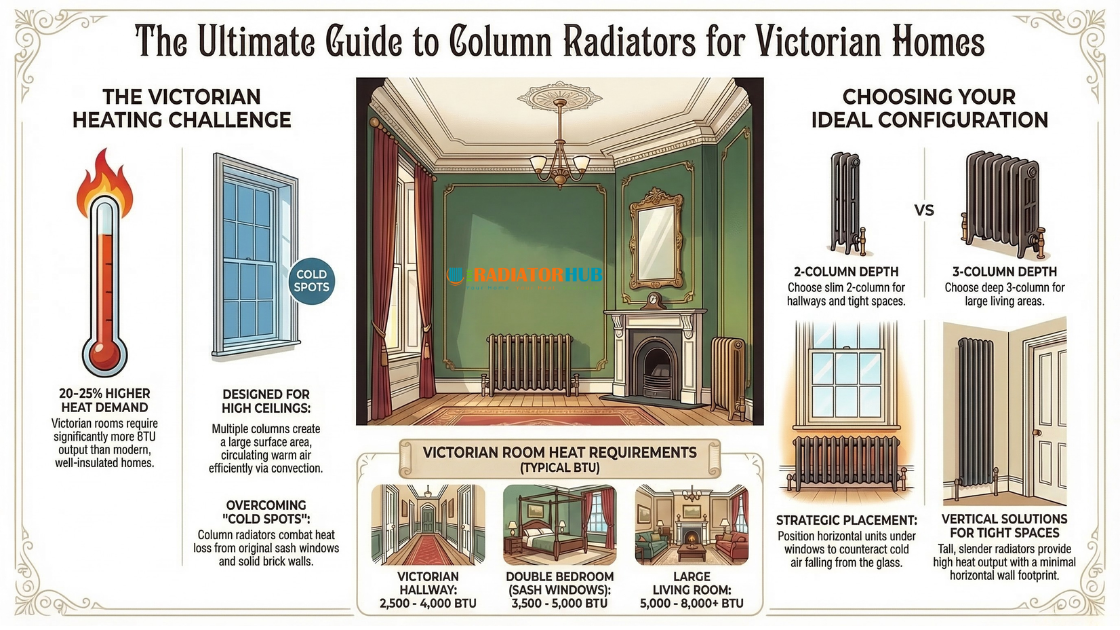
Victorian homes are wonderful to live in, until winter hits and you realise that high ceilings, solid brick walls, and single glazed sash windows are doing their best to defeat your heating system.
The good news is that column radiators were practically invented for properties like this. Not only do they carry the aesthetic DNA of the original cast iron radiators that heated Victorian houses over a century ago, but modern steel versions are dramatically more efficient, available in a huge range of sizes, and fully compatible with today’s combi boilers and heat pumps.
This guide cuts through the noise to tell you exactly what to look for, how to size your radiator correctly, and which column radiator styles work best in period properties.
Why Column Radiators Are the Right Choice
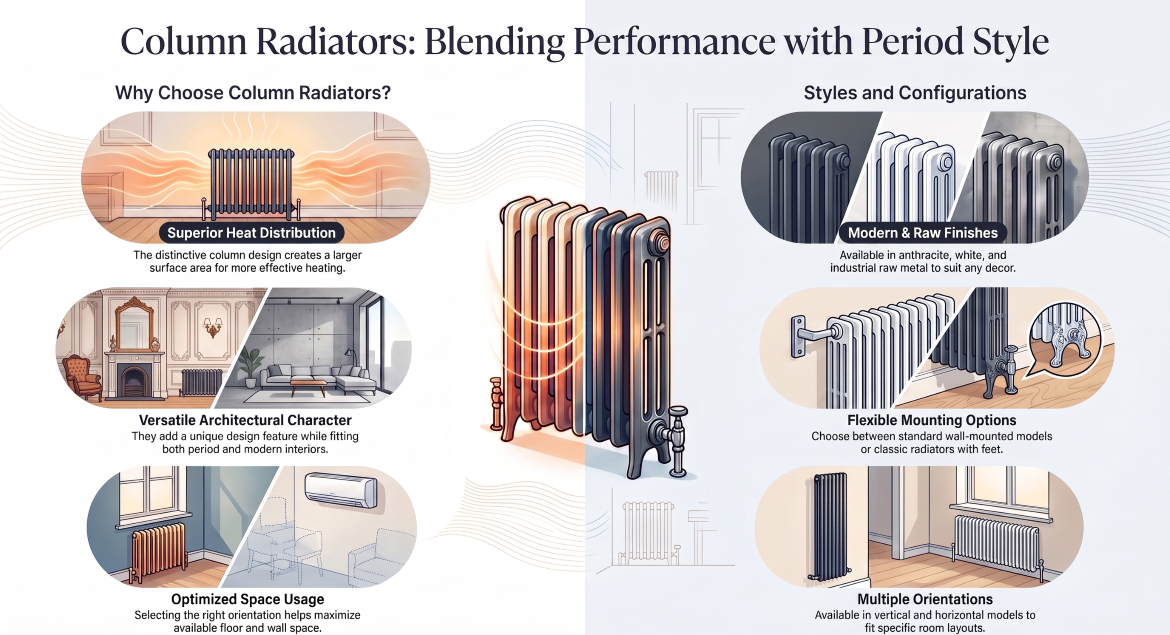
Column radiators work by creating a large heated surface area across multiple vertical tubes (the “columns”). As hot water circulates through those tubes, warm air rises by convection, circulating heat efficiently around the room.
Compared to a single or double panel radiator of similar width, a 3-column radiator can produce significantly more BTU output because the additional column depth dramatically increases the surface area. That makes them particularly effective in the larger rooms and taller spaces you typically find in period properties.
They also happen to look exactly right in a Victorian home. The multi-column silhouette directly references the original cast iron radiators installed in these properties during the late 19th and early 20th centuries, without the weight, the slow warm-up time, or the compatibility issues that come with genuine antique cast iron.
Browse the full range of column radiators at The Radiator Hub to see all available sizes, styles, and finishes.
Understanding Column Numbers: 2-Column vs 3-Column
This is where many buyers get confused, so let us keep it simple.
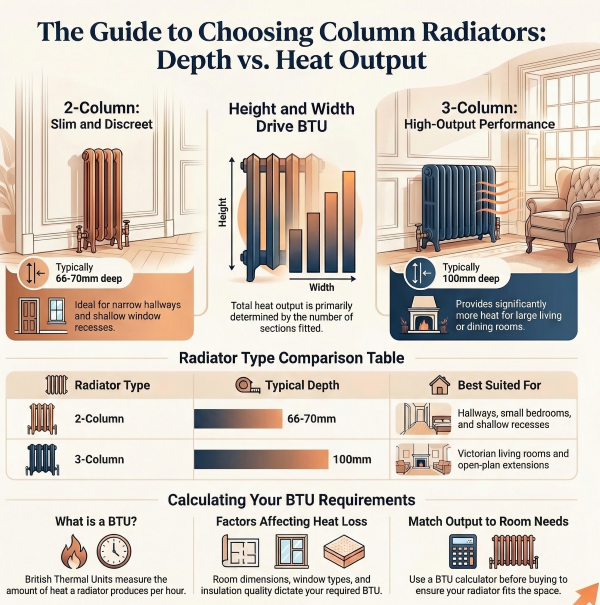
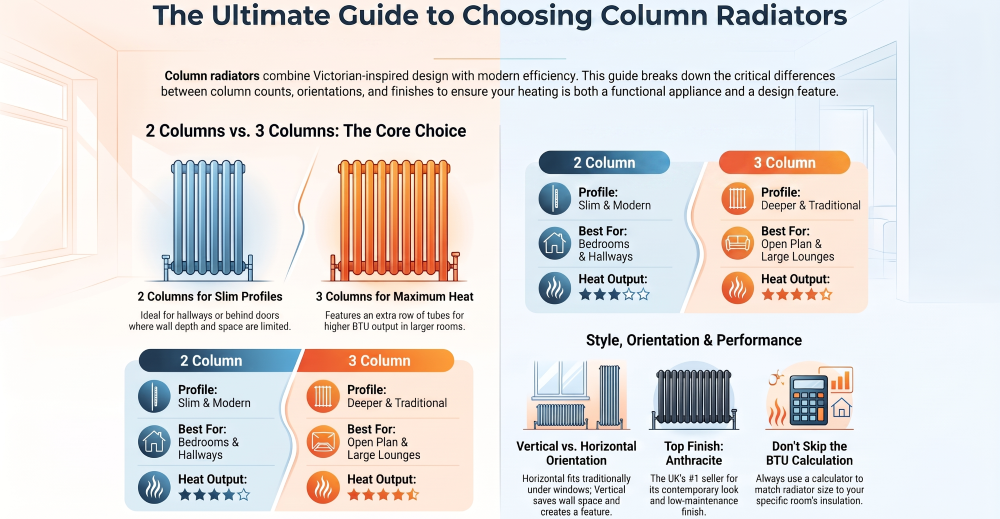
The number of columns tells you how deep the radiator is and, broadly, how much heat it produces. The height and width determine how many sections fit in, and sections are what really drive BTU output. But column count matters for matching the radiator to both your room’s heating demand and the available wall depth.
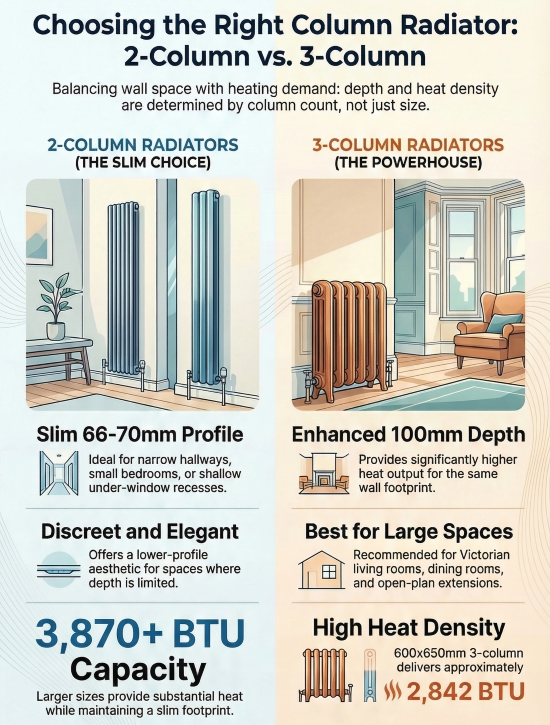
2-column radiators are slimmer, typically around 66-70mm deep, and ideal for rooms where you want a more discreet, elegant profile. They suit hallways, smaller bedrooms, and any space where the radiator sits in a shallow recess or under a window board with limited clearance. The Aura 2 Column range at The Radiator Hub starts from around £149 and runs to 3,870 BTU and above for larger sizes.
3-column radiators are deeper – typically around 100mm – and deliver considerably more heat output for their footprint. A 3-column radiator 600mm tall and 650mm wide produces around 2,842 BTU; stretch it wider or taller and output climbs quickly. For large Victorian living rooms, dining rooms, and open-plan kitchen extensions, a 3-column is often the minimum worth considering.
How to Calculate the Right BTU for Your Victorian Room
Buying a radiator without calculating your BTU requirement first is like buying shoes without knowing your size. You might get lucky, but the odds are not in your favour.
BTU (British Thermal Unit) measures the heat output a radiator produces per hour. For a Victorian home, the calculation needs to account for:
- Room dimensions (length × width × height)
- Number and type of windows (original sash windows lose heat quickly)
- Whether the room is on an external wall
- Insulation quality
- Which direction the room faces
The fastest and most accurate way to do this is to use The Radiator Hub’s free BTU Calculator. Enter your room details and it will tell you exactly how much heat output you need – then you can match that to the right radiator.
As a very rough benchmark for typical Victorian rooms:
Room | Approximate BTU Requirement |
Victorian hallway (narrow, north-facing) | 2,500-4,000 BTU |
Double bedroom with sash windows | 3,500-5,000 BTU |
Large Victorian living room | 5,000-8,000+ BTU |
Victorian kitchen/diner | 4,000-6,000 BTU |
These figures vary considerably depending on your specific property, so always use a calculator rather than guessing.
Horizontal vs Vertical Column Radiators: Which Should You Choose?
Both formats work well in period properties, but they serve different spaces.
Horizontal Column Radiators
The traditional format. Long, low, and wall-mounted, horizontal column radiators sit naturally under windows which is actually the best position for any radiator, because the rising warm air counteracts the cold draught falling from the glass.
In a Victorian living room with a bay window, a long horizontal 2 or 3-column radiator positioned beneath the bay can transform both the look of the room and the comfort of it. They are also ideal along the long walls of Victorian dining rooms and kitchens.
→ Shop Horizontal Column Radiators
Vertical Column Radiators
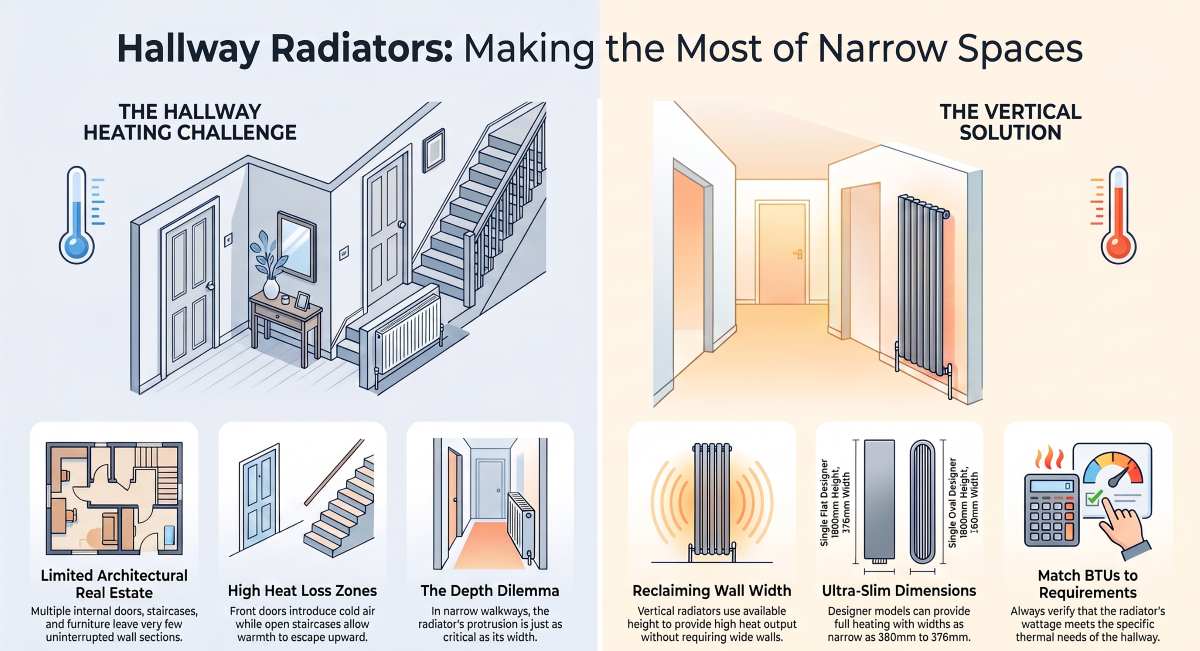
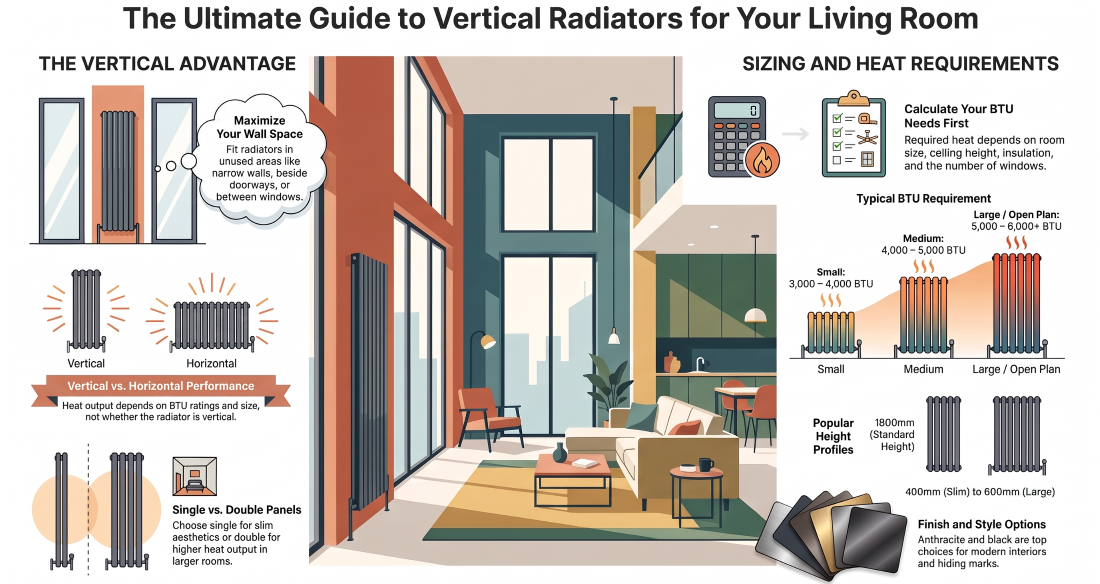
Victorian houses often have less usable wall space than you might expect. Chimney breasts, alcoves, original features, and doorways eat into available surfaces, particularly in hallways and kitchens. A vertical column radiator solves this by making use of height rather than width.
A tall, slender vertical radiator can produce impressive heat output from a wall footprint of just 200-300mm wide. The Aura 3 Column Vertical Radiator at 1800mm × 290mm, for example, delivers 3,460 BTU (1,014 watts) – enough for most Victorian bedrooms, while taking up minimal horizontal wall space at £179 including VAT and free delivery.
They also look genuinely striking in a period hallway, where the tall, column-like form echoes the architectural proportions of the house itself.
Room-by-Room Guide for Victorian Homes
Victorian Hallways
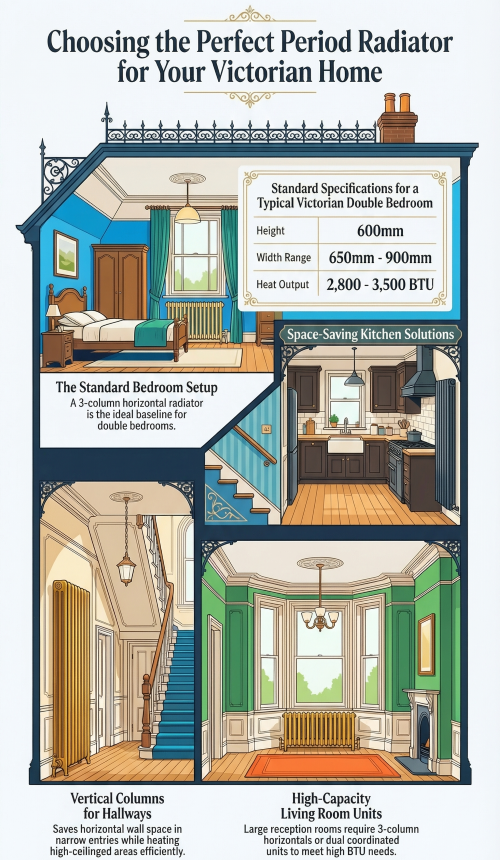
Hallways in period properties are often cold, narrow, and lacking in wall space. A tall vertical column radiator is usually the best solution – it heats the space efficiently, looks elegant against high walls, and frees up the limited horizontal space that might be needed for furniture.
Victorian Living Rooms
For large, high-ceilinged reception rooms, do not underestimate your heat requirement. Use the BTU calculator first, then consider a long 3-column horizontal radiator or, where you have two separate walls to work with, two coordinated radiators rather than one very long unit. Browse living room radiators here.
Victorian Bedrooms
A 3-column horizontal radiator at 600mm height and 650-900mm wide is a solid starting point for a double bedroom, typically delivering 2,800-3,500 BTU. If the room is north-facing or particularly large, go wider or move up to a 3-column. See bedroom radiators here.
Victorian Kitchens and Kitchen Extensions
Where wall space is tight, a vertical column radiator tucked beside a doorframe or between units is often the most practical option. Many homeowners choose an anthracite finish here to complement dark cabinetry.

Choosing the Right Finish
The finish you choose should reflect both the interior style and how the radiator will be used.
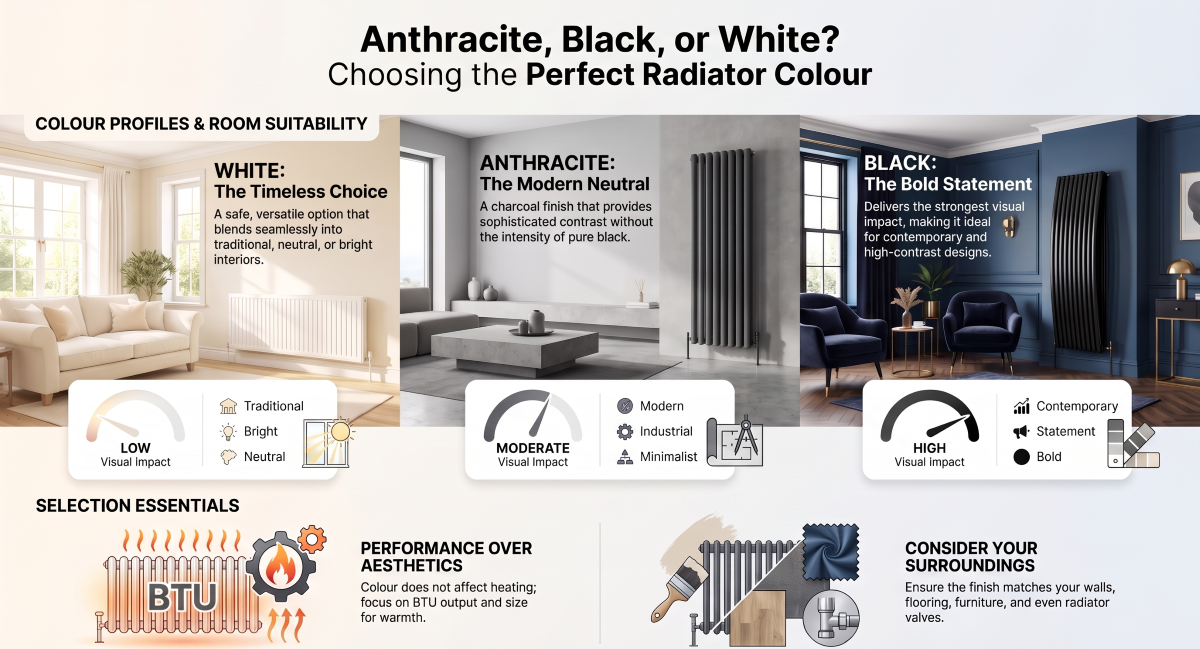
White is the most traditional finish and the easiest to live with, it recedes into the room, suits original Victorian colour schemes, and is simple to touch up. The white column radiator range covers both 2 and 3-column options in multiple sizes.
Anthracite has become one of the most popular radiator finishes across the UK, and for good reason. It works brilliantly in both restored-period and contemporary-renovated Victorian homes, particularly against dark paint colours and in kitchens. See the anthracite column radiator range here.
Raw metal is for those who want something more industrial or textural. The brushed, uncoated steel look works well in urban-Victorian conversions and adds warmth of a different kind to the room. Browse raw metal column radiators here.
Practical Tips for Installing Column Radiators in Victorian Properties
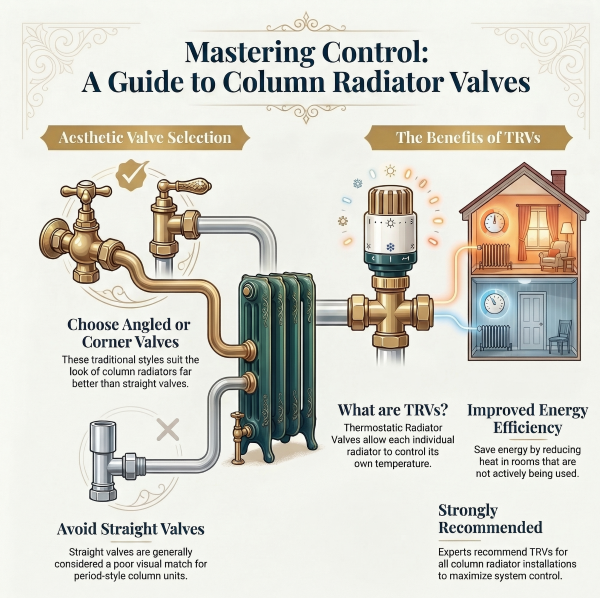
Get your valve style right. Traditional angled or corner valves suit the look of column radiators far better than straight valves. Thermostatic radiator valves (TRVs) are strongly recommended, they let each radiator control its own temperature and save energy in rooms you are not actively using. Browse radiator valves here.
Check your wall construction. Solid brick walls require appropriate fixings, consult your installer if you are in any doubt, as column radiators are heavier than flat panel equivalents.
Balance your system. If you are adding or replacing multiple radiators, ask your heating engineer to re-balance the system. This ensures hot water distributes evenly and every radiator heats up as intended.
Consider a heat pump. Modern column radiators are fully compatible with air source and ground source heat pumps. The larger surface area of a 3-column radiator actually makes it better suited to the lower flow temperatures that heat pumps operate at, compared to a slim flat panel.
Questions People Are Asking About Column Radiators
What are the best column radiators for Victorian-style homes in the UK?
Modern steel column radiators, particularly 2-column and 3-column designs are the closest you can get to the original cast iron radiators installed in Victorian properties, but with far better performance. For most Victorian homes, a 3-column horizontal radiator under the main windows is the go-to choice for living rooms and bedrooms, while a vertical column radiator works best in narrow hallways and kitchens. The Aura range at The Radiator Hub covers all of these in white, anthracite, and raw metal finishes with a 5-year warranty and free UK delivery.
What are the benefits of choosing column radiators?
The main benefits are heat output, aesthetics, and versatility. Column radiators produce more BTU per unit of width than flat panel equivalents because the multiple columns dramatically increase the heated surface area. They also look authentic in period properties in a way that a modern flat panel never quite does. Add to that the availability of both horizontal and vertical formats, multiple finishes, and compatibility with every type of central heating system including heat pumps, and they are hard to argue against for older homes.
How do you calculate the correct BTU for a column radiator?
BTU (British Thermal Unit) is the measure of how much heat a radiator produces per hour. To get the right figure for your room, you need to factor in floor area, ceiling height, number of windows, wall insulation, and whether the room faces north or south. The fastest way to do this accurately is to use The Radiator Hub’s free BTU Calculator, enter your room details and it tells you exactly what output you need. For Victorian homes, always add a buffer of around 20% on top of the calculated figure to account for higher ceilings and older insulation standards.
Are column radiators efficient?
Yes. Modern steel column radiators heat up faster than traditional cast iron, respond more quickly to thermostat changes, and when correctly sized, produce excellent heat output relative to the water volume they contain. Pairing them with thermostatic radiator valves (TRVs) increases efficiency further by letting each room self-regulate. The key to efficiency in any radiator is correct sizing: an undersized radiator running constantly is far less economical than a correctly sized one cycling properly.
How do you choose the right size column radiator for a large room?
Start with a BTU calculation for the specific room. Large Victorian rooms, think a 5m × 7m reception room with high ceilings and bay windows – can easily need 6,000-8,000 BTU or more. A single 3-column horizontal radiator in a wider size (say 900-1200mm) can cover part of that demand, but for very large rooms it is often better to use two radiators on different walls rather than one very long unit. This also improves heat distribution. Use the BTU Calculator to find your exact requirement, then check the output figures listed on each product page before buying.
Are vertical column radiators efficient for heating large rooms?
They can be, but they are not always the first choice for very large rooms. Vertical column radiators excel in spaces where wall width is limited in hallways, kitchens, rooms with multiple doorways or alcoves. A tall vertical 3-column radiator at 1800mm can deliver over 3,400 BTU, which is more than enough for a bedroom or a smaller living space. For a large Victorian reception room with plenty of wall space, a long horizontal radiator or a pair of radiators will usually be more effective because the heat is distributed more evenly across the room. Browse vertical column radiators here.
Are vertical radiators better than horizontal radiators?
Neither is universally better , they suit different situations. Horizontal radiators are the traditional choice and work best positioned under windows, where the rising warm air counteracts cold air falling from the glass. Vertical radiators are the practical choice when horizontal wall space is limited. In a Victorian home you will often use both: a horizontal radiator in the living room and bedroom, and a vertical one in the hallway or kitchen.
Where should radiators be placed in a room?
The most effective position is under or close to a window. Cold air from the glass falls towards the floor. The radiator’s rising warm air interrupts that and creates a more even room temperature. In rooms without a suitable window wall, or where a window seat or wide sill makes under-window placement impossible, the next best option is on an external wall, where the heat can counteract the cold coming through the brickwork. Avoid placing radiators on internal walls where possible, as this can create uneven temperature distribution.
Where can I buy traditional column radiators online in the UK?
The Radiator Hub stocks a full range of 2-column and 3-column radiators in horizontal and vertical formats, in white, anthracite, and raw metal finishes. All orders come with free UK delivery, a 5-year warranty, and the option to spread the cost with Klarna or PayPal. For a wider selection, our sister site Designer Radiator Showroom also carries an extended range of column radiator styles.
What guarantee do The Radiator Hub’s column radiators come with?
All radiators at The Radiator Hub come with a 5-year manufacturer’s warranty, with free UK delivery included as standard.
Ready to Find Your Perfect Column Radiator?
Whether you are renovating a Victorian terrace in Lancashire, restoring a period semi in the Midlands, or upgrading a classic townhouse in the North West, column radiators give you the heat output and the heritage look to do the job properly.
Start by calculating your BTU requirement with our free heating calculator, then browse the full column radiator range at The Radiator Hub – or call the team on 01257 452 879 (Mon-Fri, 9am-5pm) if you’d like advice on sizing or specification.
Free UK delivery. 5-year warranty. Spread the cost with Klarna or PayPal.